Labels

Showing posts with label ENGINEERING. Show all posts

Friday, November 16, 2018

What is autopilot? How does it work?

 Watch our video -

How to Know Your Plane Part 1

Auto pilot flying aircraft by its own thru computer system.
Flight path stored In flight management and guidance computer. Any modifications required by NOTAMS notices carried out pilot thru MCDU.
Auto pilot command execute by ELAC elevator and aileron computer and FAC flight augmentation computer with AUTO THRUST. So auto pilot controls speed,attitude, altitude hold only and flight envelope protection. Auto thrust controls auto engine thrust in combination with auto pilot. Now pilot need to monitor and communicate with towers on regular intervals.Essentially, autopilot is a very smart and powerful computer that works similarly to a GPS. It can assist the pilot in flying the plane from departure to the touchdown at its final destination.
The autopilot is more accurately described as the automatic flight control system (AFCS). An AFCS is part of an aircraft's avionics -- the electronic systems, equipment and devices used to control key systems of the plane and its flight. In addition to flight control systems, avionics include electronics for communications, navigation, collision avoidance and weather. The original use of an AFCS was to provide pilot relief during tedious stages of flight, such as high-altitude cruising. Advanced autopilots can do much more, carrying out even highly precise maneuvers, such as landing an aircraft in conditions of zero visibility.
The first are the elevators, which are devices on the tail of a plane that control pitch (the swaying of an aircraft around a horizontal axis perpendicular to the direction of motion). The rudder is also located on the tail of a plane. When the rudder is tilted to starboard (right), the aircraft yaws -- twists on a vertical axis -- in that direction. When the rudder is tilted to port (left), the craft yaws in the opposite direction. Finally, ailerons on the rear edge of each wing roll the plane from side to side.
Watch our video -

Major component of Aircraft


Autopilots can control any or all of these surfaces. A single-axis autopilot manages just one set of controls, usually the ailerons. This simple type of autopilot is known as a "wing leveler" because, by controlling roll, it keeps the aircraft wings on an even keel. A two-axis autopilot manages elevators and ailerons. Finally, a three-axis autopilot manages all three basic control systems: ailerons, elevators and rudder.
**Heading Hold
This will set the desired direction or heading that the pilot wants the plane to take. However, this doesn’t take into account changes due to wind or the desired route; the pilot has to correct that himself.
**Heading and Navigation
This setting will hold a direction as well as navigation. It’s similar to an automated car in that it follows the navigator’s input. The pilot continues to monitor as the plane flies.
**Altitude Hold
In addition to everything above, this feature allows the pilot to set a desired altitude that the aircraft will fly. Some planes have a fancier altitude hold that lets the pilot set a desired climb or descend rate that will make the aircraft automatically climb or descend and then hold that altitude.
**Instrument Approaches
This type of autopilot will fly preprogrammed instrument approaches. The only time the pilot has to take over is to execute the landing.
Why do Airbus aircraft have two auto pilot buttons?
They are controls for two separate autopilot systems that have the same functions, and serve as a backup and crosscheck for each other.
The vast majority of aircraft used by airlines have multiple autopilot systems. These autopilots are essentially the same, they act as backups in case one of the systems fails. The number of autopilot systems depends on the complexity of the aircraft. A Dash 8 has two... A B-767 has three.
Normally one autopilot at a time handles the flying of the airplane. An exception to this rule typically occurs in approach mode, when two (in the Dash anyway) autopilot systems at a time are tied into the flight guidance computer to allow for immediate redundancy should one autopilot fail so near to the ground.
**NOTE
Notwithstanding FAR 135.93(d), autopilot minimum-use altitudes do not apply to autopilot operations when an approved automatic landing system mode is being used for landing. Automatic landing systems must be authorized in an operations specification issued to the operator, however.
Kindly refer the available sources for more information,

Dont Fail to LIKE our Facebook page 


Dont Fail to LIKE our YouTube Channel 

What is Ground Power Unit (GPU)?

 Watch our video -

How to Know Your Plane Part 1


The Red Box range of ground power units (GPU) are designed to offer every variation of power needed for Aircraft, Vehicles, the rail industry and the military.
We have a full range of portable start units (including lithium GPU’s), continuous DC power supplies, combination start and continuous power units, transformer rectifier units.
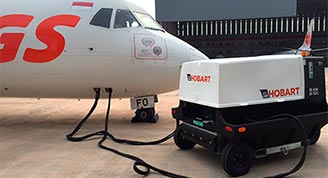
This is a ground power unit (GPU) which supplies the aircraft with electricity while the generators or the auxiliary power unit (APU) are not running. This is important especially during boarding, when the cabin lighting needs to remain on for passengers to embark or disembark. The GPU is also used to start the APU, which in turn provides electricity to start the engines and the generators. A ground power unit (GPU) is a vehicle capable of supplying power to aircraft parked on the ground. Ground power units may also be built into the jetway, making it even easier to supply electrical power to aircraft.
Many aircraft require 28 V of direct current and 115 V 400 Hz of alternating current. The electric energy is carried from a generator to a connection on the aircraft via 3 phase 4-wire insulated cable capable of handling 261 amps (90 kVA). These connectors are standard for all aircraft, as defined in ISO 6858.
Ground Power Unit. The GPU is usually diesel powered generator that outputs a very specific voltage on a connector. This connector is connected to the Nose of the aircraft to provide the electrical power. These are also available in special electrical to electrical converting equipment to eliminate the need for the Diesel engine. These are usually called FEP and were usually found at hubs. I should mention that onboard APU’s are quite loud and this is the reason they’re sometimes band at the gate.
Since the GPU takes care of the electrical power needs on the ground at the gate, the next question is air conditioning, either heating or cooling. This is taken care of from ground sources through traditional means with the conditioned air routed through large expanding yellow pipes which plug into the bottom of the airplane. This air then goes through the air ducts of the airplane to keep it cool or warm. Again, significantly cheaper than the wear and tear of the onboard packs and expense of running the APU. The auxiliary air is commonly found powered by Diesel engines or via electrical power mounted under the jet bridge.
The above two methods are used in just about every aircraft turn at the gate and allows the on-board APU to be be shutdown but the aircraft still have power and cool/warm air.
The typical sequence for push back is to start the onboard APU (usually by routing electrical power from the GPU connected to save on battery wear and tear). Once the onboard APU is running, the ground power and ground air conditioning (this is called low pressure air) are connected and the aircraft now powers itself independently. The tug pushes the airplane back, main engine is started and eventually APU shut down as the electric and air power come from the main engines.
Watch our video -

Major component of Aircraft


However, occassionally, the onboard APU might be inoperable. This means that in order to start the main engines, a high pressure and high volume air source is needed to turn the main engines for starting.
This is achieved through the use of an air-start cart. These are massive, usually >300hp. Most are large Diesel engines turning large compressors as these are cheaper to maintain and fuel. However, in some extreme cases, such as the 777-300ER, the amount of air needed is *massive* and larger than readily available compressors or Diesel engines can provide. The options are to link several smaller units together or to take an on-board style APU and mount it to a cart to be used. In some cases, smaller compressors are used to feed large tanks which release their energy to the main engine to start.
The start up sequence in this case is that the GPU is left hooked up and a high pressure air cart is hooked up. A main engine is started using the external high pressure air. Once the main engine is running, a brave ground handling person very carefully crawls under the airplane to unhook the high pressure air hose and the GPU cable. Once removed and airplane free, it is then pushed back and continues as normal.
Aircraft is powered by external electrical power ("ground power").
1. Switch on batteries. Aircraft is now electrically powered from external power.
2. Start APU by using external electrical power. Aircraft is now electrically powered from APU generator.
3. Disconnect external power.
4. Start engines with bleed air from APU. Aircraft is now electrically powered from engine generators.
5. Stop APU.

Dont Fail to LIKE our Facebook page 


Dont Fail to LIKE our YouTube Channel 

Tuesday, November 13, 2018

Aircraft Oxygen Cylinders


“Aviator’s breathing oxygen” is marked on all oxygen cylinders designed for use in Aircraft. 

Watch our video -

Major component of Aircraft


Gaseous oxygen is stored in high-pressure cylinders rated for 1800–1850 psi of pressure and capable of maintaining pressure up to 2,400 psi.

Most oxygen storage cylinders are painted green, but yellow and other colors may be used as well.


The manufactured date, certication number and hydrostatic test dates are stamped on each cylinder near the neck. 

Oxygen cylinders are considered empty when the pressure inside drops below 50 psi.

Any installed tank allowed to fall below this pressure should be removed from service because water get entrapped and corrode the cylinder walls.

Dont Fail to LIKE our Facebook page 


Dont Fail to LIKE our YouTube Channel 
Ice formation on Pitot-Static System

1. If the pitot tube becomes blocked, and its drain hole 
remains clear, the airspeed will read zero.

   Watch our video -

Major component of Aircraft


2. If the pitot tube and its drain hole are blocked, the airspeed indicator will act like an altimeter, reading higher airspeeds with an increase in altitude.

3. If the static port(s) become blocked and the pitot tube remains operable, the airspeed indicator will barely work and indications will be inaccurate.


Dont Fail to LIKE our Facebook page 


Dont Fail to LIKE our YouTube Channel 

Flight Management System


FMS is like the GPS in your car, with waypoints programmed in between the origin and the destination. You program in where you are going, and the FMS will allow the airplane to hook up with the autopilot, and maintain the heading within a few feet accuracy.
  Watch our video -

Major component of Aircraft

The flight path is not always straight and it will find the most efficient path to fly between the destinations.

If you are flying toward a place where there's a thunderstorm en route, and the dispatcher may send an ACARS text message saying, "There's a thunderstorm, consider rerouting." Then the pilot will send back a message saying, "I got it, thanks,"

ACARS messages can be sent by text, but some aircraft have the ability to uplink by voice as well. The system also allows us to pull up the weather.


Watch our video -

How to Know Your Plane Part 1


Pilot can enter information from the ACARS into the FMS, but that doesn't happen automatically.


Dont Fail to LIKE our Facebook page 


Dont Fail to LIKE our YouTube Channel 

Saturday, November 10, 2018

Engine Bleed Air System

The Engine Bleed Air System is a sub-system of the Bleed Air System that is installed directly within the aircraft engine. 
It allows air to be bled from several engine ports in order to ensure sufficient pressurised air is provided to consumers* 
which include:
Watch our video -

How to Know Your Plane Part 1


• Engine starting (including cross starting)
• Wing anti-ice system
• Cabin pressurisation
• Fuel Tank Inerting System (FTIS)
• Cabin air generation and cooling systems (ATA21)
• Pressurisation of hydraulic tank, as well as waste and water storage tanks

Earlier generation families such as the A320ceo and the A330ceo are fitted with full pneumatic Engine Bleed Air Systems whereas more recent programmes are fitted with electro-pneumatic systems.


Dont Fail to LIKE our Facebook page 


Dont Fail to LIKE our YouTube Channel 

Friday, November 9, 2018

Isotopes


The atoms of two or more forms of an element having the same atomic number but different atomic mass numbers are called isotopes.
Watch our video -

How to Know Your Plane Part 1


In other words, the atoms of isotopes will have an equal number of protons (Figure) but differing numbers of neutrons.
For example, isotopes of a Carbon element consist of 6 protons but varying number (6, 7 or 8) of neutrons., And these isotopes are named Carbon-12, Carbon-13 and Carbon-14 respectively.
The chemical properties of different isotopes of an element are identical, but they differ in nuclear stability.

Dont Fail to LIKE our Facebook page 


Dont Fail to LIKE our YouTube Channel 

Thursday, November 8, 2018

Refractive Index

A fiber-optic cable is composed of two concentric layers, called the core and the cladding, as illustrated in Figure.

The core and cladding have different refractive indices, with the core having a refractive index of n1, and the cladding having a refractive index of n2. 

Watch our video -

How to Know Your Plane Part 1


The refractive index of the core, n1, is always greater than the index of the cladding, n2. Light is guided through the core, and the fiber acts as an optical waveguide.

The index of refraction is a way of measuring the speed of light in a material. Light travels fastest in a vacuum. The actual speed of light in a vacuum is 300,000 kilometers per second, or 186,000 miles per second.


Dont Fail to LIKE our Facebook page 


Dont Fail to LIKE our YouTube Channel 

In a typical commercial cabin air recirculation system, the air supplied into the cabin consists of approximately:

50% outside air from either the engine's compressor stage (engine 'bleed air') or the Auxiliary Power Unit (APU) mixed with approximately, and the other 50% of filtered, recirculated air.
Watch our video -

How to Know Your Plane Part 1


However, the new generation of airplane (B787) do not use bleed air..
Dont Fail to LIKE our Facebook page 


Dont Fail to LIKE our YouTube Channel 

Engine cleaning with dry ice, the solid form of carbon dioxide (CO2).

This approach is not only efficient; it also saves water and enables engine washes to be performed at outdoor temperatures below freezing for the very first time. 
Engines can thus be washed 365 days a year anywhere in the world – even in permafrost regions.


Watch our video -

How to Know Your Plane Part 1


Dont Fail to LIKE our Facebook page 


Dont Fail to LIKE our YouTube Channel 

777 Hydraulic system

The Boeing 777 is equipped with three hydraulic systems. The left, center, and right systems deliver hydraulic fluid at a rated pressure of 3,000 psi to operate flight controls, flap systems, actuators, landing gear, and brakes.

Watch our video -

How to Know Your Plane Part 1


The center system provides hydraulic power for
- the engine thrust reversers,
- primary flight controls,
- Nose and Main landing gear actuation and steering.
- flaps/slats.
Under emergency conditions, hydraulic power is generated by the ram air turbine (RAT), which is deployed automatically and drives a variable displacement inline pump. The RAT pump provides flow to the center system flight controls.

Dont Fail to LIKE our Facebook page 


Dont Fail to LIKE our YouTube Channel