

Watch our video -
How to Know Your Plane Part 1
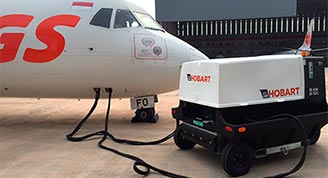

The Red Box range of ground power units (GPU) are designed to offer every variation of power needed for Aircraft, Vehicles, the rail industry and the military.
We have a full range of portable start units (including lithium GPU’s), continuous DC power supplies, combination start and continuous power units, transformer rectifier units.
This is a ground power unit (GPU) which supplies the aircraft with electricity while the generators or the auxiliary power unit (APU) are not running. This is important especially during boarding, when the cabin lighting needs to remain on for passengers to embark or disembark. The GPU is also used to start the APU, which in turn provides electricity to start the engines and the generators. A ground power unit (GPU) is a vehicle capable of supplying power to aircraft parked on the ground. Ground power units may also be built into the jetway, making it even easier to supply electrical power to aircraft.
Many aircraft require 28 V of direct current and 115 V 400 Hz of alternating current. The electric energy is carried from a generator to a connection on the aircraft via 3 phase 4-wire insulated cable capable of handling 261 amps (90 kVA). These connectors are standard for all aircraft, as defined in ISO 6858.
Ground Power Unit. The GPU is usually diesel powered generator that outputs a very specific voltage on a connector. This connector is connected to the Nose of the aircraft to provide the electrical power. These are also available in special electrical to electrical converting equipment to eliminate the need for the Diesel engine. These are usually called FEP and were usually found at hubs. I should mention that onboard APU’s are quite loud and this is the reason they’re sometimes band at the gate.
Since the GPU takes care of the electrical power needs on the ground at the gate, the next question is air conditioning, either heating or cooling. This is taken care of from ground sources through traditional means with the conditioned air routed through large expanding yellow pipes which plug into the bottom of the airplane. This air then goes through the air ducts of the airplane to keep it cool or warm. Again, significantly cheaper than the wear and tear of the onboard packs and expense of running the APU. The auxiliary air is commonly found powered by Diesel engines or via electrical power mounted under the jet bridge.
The above two methods are used in just about every aircraft turn at the gate and allows the on-board APU to be be shutdown but the aircraft still have power and cool/warm air.
The typical sequence for push back is to start the onboard APU (usually by routing electrical power from the GPU connected to save on battery wear and tear). Once the onboard APU is running, the ground power and ground air conditioning (this is called low pressure air) are connected and the aircraft now powers itself independently. The tug pushes the airplane back, main engine is started and eventually APU shut down as the electric and air power come from the main engines.
Watch our video -
However, occassionally, the onboard APU might be inoperable. This means that in order to start the main engines, a high pressure and high volume air source is needed to turn the main engines for starting.
This is achieved through the use of an air-start cart. These are massive, usually >300hp. Most are large Diesel engines turning large compressors as these are cheaper to maintain and fuel. However, in some extreme cases, such as the 777-300ER, the amount of air needed is *massive* and larger than readily available compressors or Diesel engines can provide. The options are to link several smaller units together or to take an on-board style APU and mount it to a cart to be used. In some cases, smaller compressors are used to feed large tanks which release their energy to the main engine to start.
The start up sequence in this case is that the GPU is left hooked up and a high pressure air cart is hooked up. A main engine is started using the external high pressure air. Once the main engine is running, a brave ground handling person very carefully crawls under the airplane to unhook the high pressure air hose and the GPU cable. Once removed and airplane free, it is then pushed back and continues as normal.
Aircraft is powered by external electrical power ("ground power").
1. Switch on batteries. Aircraft is now electrically powered from external power.
2. Start APU by using external electrical power. Aircraft is now electrically powered from APU generator.
3. Disconnect external power.
4. Start engines with bleed air from APU. Aircraft is now electrically powered from engine generators.
5. Stop APU.
1. Switch on batteries. Aircraft is now electrically powered from external power.
2. Start APU by using external electrical power. Aircraft is now electrically powered from APU generator.
3. Disconnect external power.
4. Start engines with bleed air from APU. Aircraft is now electrically powered from engine generators.
5. Stop APU.
Dont Fail to LIKE our Facebook page
Dont Fail to LIKE our YouTube Channel


